23 May 2026
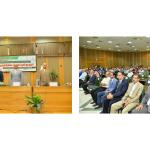
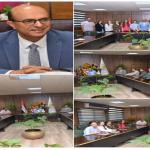
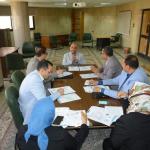
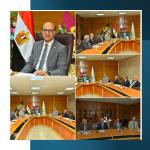
In the context of its community and awareness role, and under the patronage of Professor Ahmed El-Minshawy, President of Assiut University, the External Communication and Extension Education Center affiliated with the Community Service and Environmental Development Sector at the Faculty of Veterinary Medicine organized an awareness seminar titled “Health Specifications of Sacrificial Animals and Their Rulings.” The seminar was held under the supervision of Professor Mohamed Ahmed El-Adawy, Vice President for Community Service and Environmental Development Affairs, and Professor Inas Ahmed Abdel-Hafez, Dean of the Faculty of Veterinary Medicine.
The seminar was attended by Professor Mahmoud Rushdi, Vice Dean for Community Service and Environmental Development; Professor Hossniya El-Sewify, Director of the External Communication and Extension Education Center; Sheikh Mostafa Mansour Galal from the Asyut Endowments Directorate; and a group of faculty members, assistants, staff, and specialists in health and religious awareness.
The session was delivered by Professor Hussein Youssef Ahmed, Emeritus Professor of Meat Hygiene and Technology at the Department of Food Hygiene and Technology, who presented a comprehensive scientific overview of the key health standards required for selecting sacrificial animals, methods of ensuring their safety and meat quality, and proper practices during slaughter and storage to safeguard public health and food safety.
Professor Ahmed El-Minshawy emphasized the University’s commitment to leveraging its scientific and academic capabilities in serving the community by organizing awareness activities that enhance public health and religious awareness, particularly during occasions closely related to everyday family life. He highlighted the importance of disseminating correct knowledge regarding the selection of sacrificial animals and safe meat handling practices to support public health protection efforts.
Professor Mohamed Ahmed El-Adawy noted that the University places great importance on educational activities that directly address societal needs, stressing that awareness of food safety principles and proper health practices represents a key pillar in building a more conscious society capable of avoiding harmful behaviors.
Professor Inas Ahmed Abdel-Hafez stated that the Faculty is committed to providing scientific and educational content that serves society and raises health awareness, affirming that this seminar represents a model of integration between academic roles and community outreach.
Professor Mahmoud Rushdi emphasized that food safety begins with correct awareness, noting that the seminar aimed to introduce citizens to the proper health specifications of sacrificial animals and safe meat-handling practices to ensure public health.
Professor Hossniya El-Sewify added that the University continues to strengthen its engagement with society through purposeful awareness activities that promote healthy behaviors and reinforce a culture of prevention.
Sheikh Mostafa Mansour Galal affirmed that sacrifice (Udhiyah) is a great religious ritual based on mercy, purity, and benevolence, stressing that adherence to proper religious rulings ensures the fulfillment of its spiritual and humanitarian purpose. He called on citizens to observe both religious and health guidelines when selecting sacrificial animals.
Professor Hussein Youssef Ahmed explained that sacrificial animals must meet four main conditions: they must be from livestock (camels, cattle, sheep, and goats); they must reach the prescribed age (six months for sheep, one year for goats, two years for cattle, and five years for camels); they must be free from disqualifying defects; and they must be slaughtered within the legislated time frame, which begins after Eid prayer on the Day of Sacrifice and continues until sunset on the thirteenth day of Dhul-Hijjah.
He further elaborated on identifying the animal’s age through examination of the lower jaw incisors and the replacement of the first pair of teeth, noting that physical inspection is essential to ensure eligibility for sacrifice.
He also clarified that defects such as obvious blindness, disease, lameness, or severe emaciation invalidate the animal for sacrifice, while mild, non-debilitating conditions such as temporary diarrhea may not necessarily affect eligibility unless they impact the animal’s health or meat quality.
Additional guidelines included proper inspection methods during purchase, ensuring animal vitality and absence of secretions or infections, and checking key body areas to detect hidden defects or commercial fraud.
He also outlined proper pre-slaughter animal care, including rest periods, controlled feeding, and fasting for 12–18 hours before slaughter to improve meat quality, as well as the importance of minimizing stress to preserve meat tenderness.
The seminar further addressed food safety practices, including verification of official slaughterhouse stamps, checking expiration dates and storage conditions for refrigerated or frozen meat, and proper thawing techniques inside refrigerators rather than at room temperature.
Finally, the seminar emphasized that adherence to both religious and health regulations ensures the fulfillment of the ritual’s purpose while safeguarding family health and food safety.