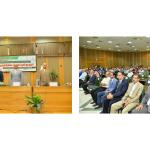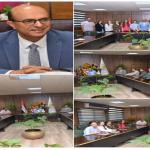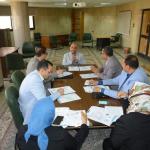
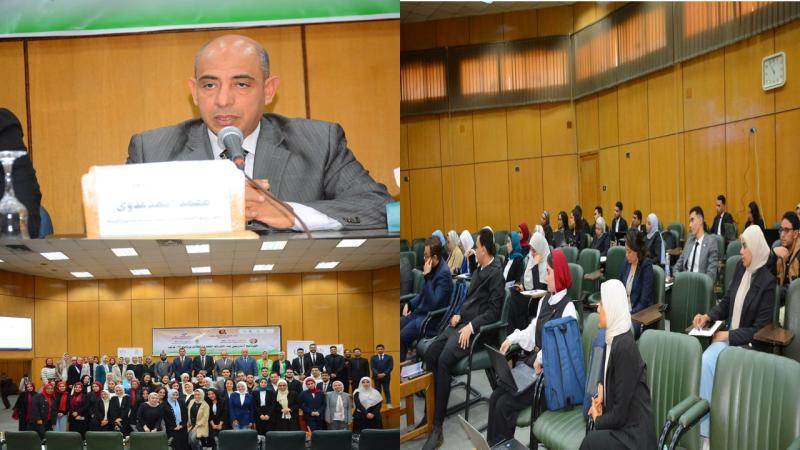
Under the auspices of Professor Ahmed El-Menshawy, President of Assiut University, the university organized, on Monday, February 9, specialized training courses for students of the Public Policy Information Systems (PPIS) programs at the Faculty of Commerce and English Translation (ETSP) at the Faculty of Arts, in cooperation with the National Center for Social and Criminal Research, under the auspices of Dr. Hala Ramadan, Director of the Center and in coordination with the Center for Monitoring and Studying Community Problems in the Community Service and Environmental Development Sector at the University.
The courses are held under the supervision of Dr. Ahmed Abdel Mawla, Vice President for Education and Student Affairs, and Dr. Mohamed Ahmed Adawi, Vice President for Community Service and Environmental Development.
The activities will continue over three days, in implementation of the cooperation protocol concluded between the two sides, and within the framework of the integration of roles between academic and research institutions to support community issues and human development.
Professor Ahmed El-Menshawy stressed that the university is keen to prepare its students and qualify them for the labor market through specialized training programs based on the integration of academic knowledge and practical application, pointing out that the cooperation with the National Center for Social and Criminal Research represents a successful model of institutional partnership aimed at building the student's personality scientifically and professionally, and enhancing his awareness of community issues.
Dr. Ahmed Abdel Mawla stressed that these training courses represent a real opportunity for students to gain practical experiences outside the traditional framework of lectures, and contribute to developing their personalities, building self-confidence, and enhancing their ability to deal with the requirements of professional life.
Professor Mohamed Adawy praised the importance of cooperation with the National Center for Social and Criminal Research, as it adds a scientific and applied dimension that contributes to raising the quality of training outputs and maximizing their societal impact. He also stressed the role of the Center for Monitoring and Studying Community Problems in providing interactive applied training that links academic knowledge with practical application, and enhances the role of the university as a main engine of development.
In the same context, Dr. Yasser El-Sayed, Coordinator of Events and Training for the Joint Cooperation Protocol, explained that these events represent a real model of partnership between the academic side represented by Assiut University, and the research and applied expertise provided by the National Center for Social and Criminal Research, in order to achieve integration between theoretical knowledge and practical experience, stressing that the real investment of any society starts from investing in its youth, and that this partnership reflects a strategic vision to achieve the knowledge and professional sustainability of university students.
The training courses are divided into two training courses over three days, the first is entitled "Advanced Capacity Building" for students of the Public Policy Information Systems (PPIS) program at the College of Commerce, during which Dr. Abdullah Sulaiman Abdullah, Assistant Professor of Statistics at the Center, will lecture, where he will review the methods of analyzing and presenting smart data using Power BI software.
The second course, titled "Career Readiness and Career Building" for students of the English Translation Program (ETSP) at the College of Arts, will be held during which Dr. Yasser Al-Sayed will present a workshop on the concept of career readiness and its importance in the graduation stage, building professional identity, career planning, interview skills and building professional networks.
Dr. Abdo Al-Ashri, Assistant Professor of Law at the Center, will also participate in a workshop on legal awareness for youth as a safe gateway to the labor market and entrepreneurship, in addition to a workshop presented by Dr. Ghada Riyad, Economics Lecturer at the Center, on the job needs in the labor market, mechanisms for joining it, ways to achieve professional success, and choosing the appropriate career path for university students.
For his part, Dr. Ali Kamal Mabad, Director of the Center for Monitoring and Studying Community Problems, explained that these courses come within the framework of the university's mission to serve the community and develop the environment, and embody the vision of the Egyptian state in investing in human capital, stressing that the training programs contribute to building the capacities of students and graduates through contemporary training content based on scientific research and related to the actual issues of society.
Dr. Asmaa Gaber Mahran, Deputy Director of the Center and Protocol Coordinator at the University, pointed out that the training courses are designed according to a scientific methodology that takes into account national priorities and supports the goals of Egypt's Vision 2030 and the Higher Education Strategy, explaining that the programs aim to develop cognitive and practical skills, consolidate the values of citizenship and social responsibility, and enhance awareness of contemporary social issues, in a way that qualifies cadres capable of actively participating in sustainable development efforts.