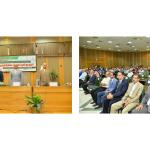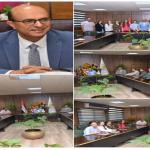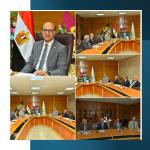
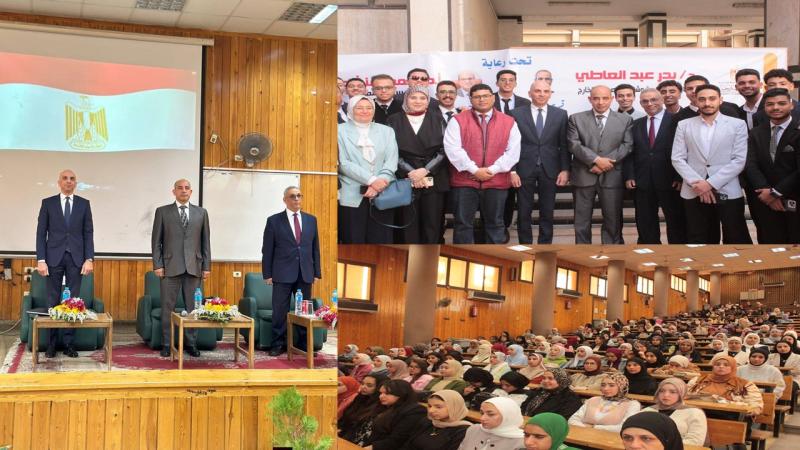
Under the patronage of Professor Ahmed El-Menshawy, President of Assiut University, Ambassador Tamim Khalaf, the official spokesman of the Ministry of Foreign Affairs, Immigration and Egyptians Abroad, presented an awareness seminar for Assiut University students entitled "The Role of Egyptian Diplomacy in Facing Regional Challenges", on Monday, February 9, as part of a series of events and activities organized by the university to enhance students' awareness of regional and international issues.
The seminar was attended by Dr. Mohamed Ahmed Adawi, Vice President for Community Service and Environmental Development, and Dr. Alaa Abdel Hafeez, Dean of the Faculty of Commerce, along with a group of faculty members and their assistants from various faculties of the university, and a group of students.
Professor Ahmed El-Menshawy praised the lecture delivered by Ambassador Tamim Khalaf, Spokesperson of the Ministry of Foreign Affairs, Immigration and Egyptian Affairs Abroad, stressing that it reflected the depth of the Egyptian vision in managing regional and international issues, and contributed to simplifying the concepts of foreign policy for students and enhancing their awareness of the role of Egyptian diplomacy in protecting national interests and supporting peace and stability efforts.
Professor Mohamed Adawy also stressed the importance of the role played by the Egyptian Ministry of Foreign Affairs in developing the knowledge and capabilities of university students on foreign policy issues, especially in the African continent and brotherly countries, and highlighting Egypt's pivotal role in supporting security and development efforts.
Dr. Alaa Abdel Hafeez stressed that the college's hosting of this symposium reflects the university's keenness to link academic study with contemporary national and regional issues, pointing out the importance of providing such awareness meetings to students, as they play a role in expanding their perceptions, enhancing their understanding of the nature of regional and international variables, and building awareness capable of analyzing and interacting with events within the framework of the national interest.
Ambassador Tamim Khalaf explained that Egypt's foreign policy is based on several main constants and principles, namely: respect for the sovereignty of states, the unity and territorial integrity of their territories, support for the concept of the national state and its institutions, commitment to international law and the United Nations Charter, and continuous keenness to support security, peace and stability and the peaceful settlement of disputes, stressing that adherence to these principles has strengthened Egypt's credibility and international standing.
Ambassador Tamim Khalaf stressed the stability of the Egyptian position towards the Palestinian cause, pointing out that since the beginning of the Arab-Israeli conflict, Egyptian diplomacy has adopted an approach in support of peace based on justice, and ensuring that the Palestinian people obtain all their legitimate rights in their independent state.
The spokesperson reviewed the pivotal role played by Egypt since the outbreak of the Israeli war on the Gaza Strip, explaining that the Egyptian move was carried out through three main tracks, the first of which is the political track, where Egypt led intensive efforts to mobilize the international community to recognize the Palestinian state, which resulted in the recognition of it by a number of major countries, as well as its decisive response to attempts to displace Palestinians from the Gaza Strip, and its active participation in the preparation of an integrated plan for the reconstruction of Gaza.
With regard to the humanitarian track, the ambassador explained that about 70% of the humanitarian aid that entered the Gaza Strip was Egyptian aid, stressing the continuation of Egyptian efforts to intensify the flow of humanitarian, relief and medical aid. On the security track, he pointed to Egypt's main contribution through negotiations in reaching a ceasefire agreement, noting Egypt's support for efforts to establish an international stabilization force in the Gaza Strip.
Ambassador Tamim Khalaf also touched on the growing challenges surrounding Egypt's national security, addressing the challenges related to Egyptian water security, reviewing Egypt's position on the Ethiopian Dam. He also reviewed Egypt's position on the Ukraine crisis and the Iranian nuclear file, highlighting the main role played by Egypt in de-escalation and tension in the region.
At the end of the symposium, the official speaker was keen to hold an open dialogue with the students, where a discussion took place with the students on many elements and aspects of Egyptian foreign policy and what Egyptian diplomacy is doing in supporting security, peace and stability in the region.
At the end of the event, the Ambassador expressed his happiness with the positive interaction from the students of Assiut University and their conscious questions, stressing that such dialogues reflect the importance of direct communication with university youth, and enhancing their awareness of regional issues and the Egyptian role in them.