January 12, 2026
In line with Assiut University’s strategy to maximize the utilization of its productive assets, the University farms at the Faculty of Agriculture continue to play a pivotal role in supporting educational and research activities, while providing safe, high-quality food products to the university community and surrounding areas. This contributes to sustainable development, community service, and environmental enhancement, under the patronage of Professor Ahmed El-Minshawy, University President, and supervision of Professor Mohamed Adawy, Vice President for Community Service and Environmental Development.
Professor Ahmed El-Minshawy emphasized that the University farms represent a key productive and scientific arm for linking academic education with practical application. He noted that the University treats these farms as educational, research, and production units, helping to prepare graduates capable of meeting the demands of the agricultural and animal production labor market.
Professor Mohamed Adawy highlighted that the Faculty of Agriculture farms serve as a practical model for community service, providing safe, high-quality food products and supporting small-scale breeders while preserving high-value animal genetic breeds. He added that the University is currently working to increase operational efficiency and productivity in the farms and to further enhance their societal role, thereby strengthening the University’s self-generated resources and delivering tangible benefits to the local community, in alignment with the national vision for sustainable agricultural development.
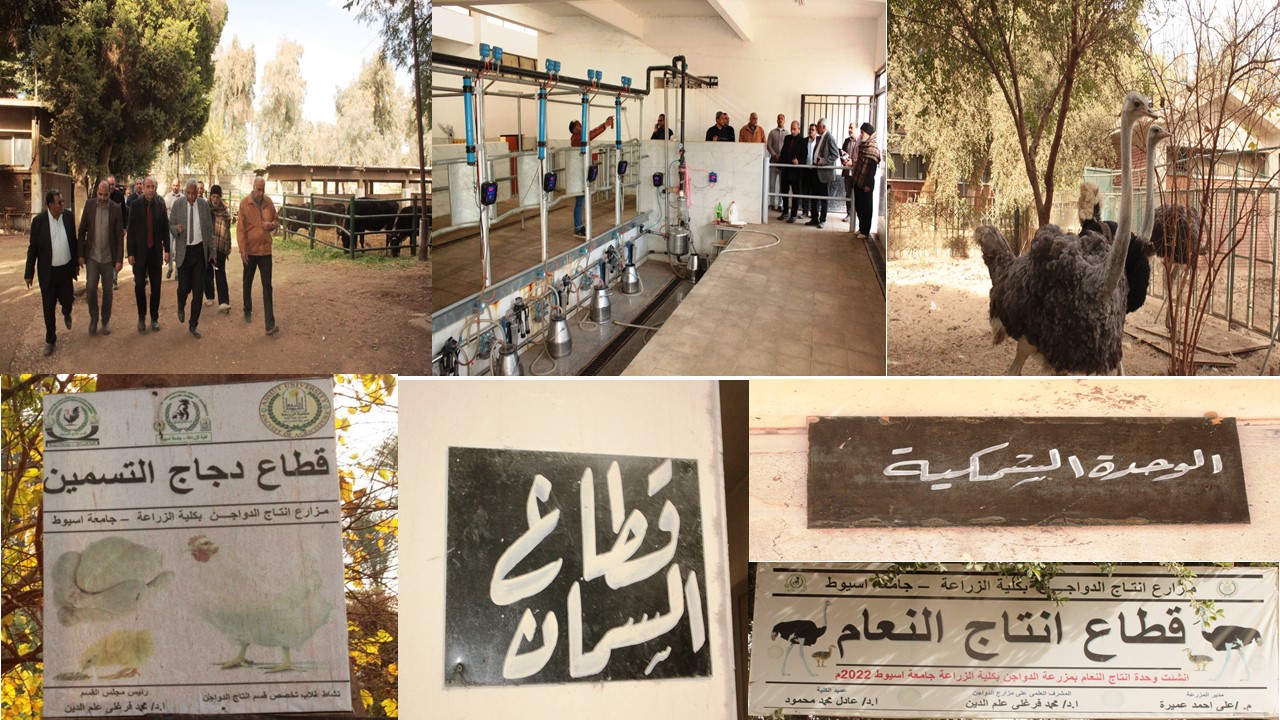
In this context, Professor Mohamed Adawy conducted an inspection tour of the University farms on Monday, January 12, accompanied by Professor Adel Mohamed Mahmoud, Dean of the Faculty of Agriculture; Dr. Galal Abdel Fattah Al-Saghir, Vice Dean for Community Service and Environmental Development; Dr. Mohsen Mohamed Farghaly, Scientific Supervisor of the Production Farm at the Department of Animal Production; Dr. Mahmoud Abdel Latif, Scientific Supervisor of the Research Farm at the Department of Animal Production; and Dr. Khaled Abu El-Ezz, Head of the Poultry Production Department and Scientific Supervisor of the Research and Production Farms. The tour focused on developing the farms, enhancing productivity, and maximizing their educational and community impact.
Assiut University farms feature a fully integrated production system, including poultry farms, animal production sectors, feed units, slaughterhouses, and fish production units, providing a diverse platform for practical education, postgraduate research, faculty research projects, and supporting the University’s self-generated resources.
The poultry farms include broiler production units, a fully equipped slaughterhouse, freezing facilities, and specialized breeding halls for strains such as Sharkasi, Dandarawi, and Fayoumi. They also host rabbits, quail, ducks, geese, turkeys, pigeons, and a distinguished ostrich sector. The farm supplies its products through the Faculty’s sales outlets and offers select high-value breeds to small local breeders.
The animal production farms comprise two main sectors: a research sector, providing animals for scientific studies and postgraduate theses, and a production sector, supplying the university community with dairy and meat products at affordable prices, with on-site slaughtering and packaging according to health standards. The farms maintain genetic diversity in valuable animal breeds, including Friesian, Jersey, Brown Swiss, Egyptian buffalo, and various sheep breeds.
The farms also feature a modern automated milking facility, used to train students in advanced animal production management techniques, along with a fully equipped slaughterhouse for fattened calves, supporting the Faculty’s sales outlets and serving an important community role during holiday seasons, particularly Eid al-Adha.
This integrated model highlights Assiut University’s commitment to combining education, research, and production to serve both its students and the wider community, while contributing to the sustainable development of agriculture and animal production in the region.