
December 1, 2025
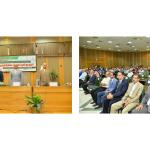
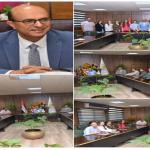
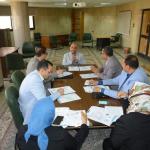
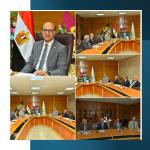
Under the patronage of Professor Ahmed El-Minshawy, President of Assiut University, the University concluded the activities of the training course entitled “Scientific and Practical Foundations for Preparing Strategic Situation Assessments” for faculty members. The course was organized by the National Center for Studies in cooperation with Assiut University during the period from 29 November to 1 December, and was held at the Faculty and Leadership Development Center in the University’s Administrative Building. The course was supervised by Major General Ahmed El-Shahabi, President of the National Center for Studies, and Professor Mohamed Adawy, Vice President of Assiut University for Community Service and Environmental Development, with the participation of a distinguished group of faculty members from various University faculties.
The concluding day of the course witnessed discussions of applied models prepared by the participants during two training sessions. Major General Dr. Ahmed Farouk, Advisor to the National Center for Studies, chaired the session on external issues, while Mr. Hani Al-Aassar, Executive Director of the Center, chaired the session on internal issues. The sessions addressed models of strategic situation assessment and scenario formulation, covering advanced themes and methodologies of situation analysis, while ensuring participants’ ability to apply analytical concepts and methods to realistic case studies.
Professor Ahmed El-Minshawy affirmed that organizing this specialized course reflects the University’s ongoing commitment to investing in human capital and developing the capacities of faculty members in line with the State’s direction toward building academic leaders capable of managing change. He noted that strategic situation assessments have become an essential tool within academic institutions, enabling accurate reading of reality, anticipation of challenges, and formulation of effective solutions, thereby supporting decision-makers in selecting the most appropriate alternatives.
For his part, Professor Mohamed Adawy stated that the course aims to raise strategic awareness and equip academic staff with tools for situation analysis and scenario planning to support decision-making. He added that the Community Service and Environmental Development Sector is keen to provide high-quality training programs that align with faculty members’ needs and enhance the University’s societal and institutional role, reflecting a clear advancement in both scientific and practical skills. He also recommended expanding the scope of such training courses and increasing the number of participants to include all academic levels, from teaching assistants to assistant lecturers, not only faculty members, and expressed his appreciation to the National Center for Studies for their dedication to delivering the program at the highest professional level.
Major General Dr. Ahmed Farouk praised the success of the course and the ideas and scenarios presented by the participants, emphasizing that preparing strategic situation assessments is not merely a report-writing exercise, but rather a complex scientific process that integrates deep knowledge, rigorous analysis, and future foresight. He stressed that assessments based on reliable data and sound analysis support decision-makers in confronting challenges, seizing opportunities, and shaping a better future.
Mr. Hani Al-Aassar reviewed the core skills required to prepare a successful situation assessment, including the ability to conduct logical and in-depth analysis, familiarity with the strategic and political environment, skills in information gathering and analysis, critical thinking and hypothesis evaluation, as well as objectivity and avoidance of bias.
In turn, Professor Jaber Megahid expressed his appreciation to both trainers and trainees, noting his satisfaction with the cooperation between Assiut University and various partner entities in supporting faculty members. He affirmed the Center’s commitment to supporting training programs aimed at developing academic staff capacities.
Participants praised the content of the training course, highlighting the richness of its scientific value, the efficiency of the trainers in delivering the material, and the role of the course in enhancing interaction among participants and facilitating the exchange of perspectives on a wide range of topics.