
November 27, 2025
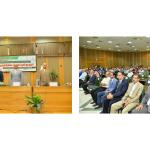
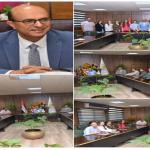
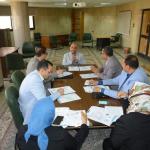
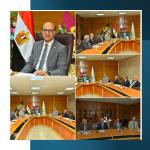
Under the patronage of Professor Ahmed El-Minshawy, President of Assiut University, Professor Mohamed Adawy, Vice President of the University for Community Service and Environmental Development, conducted a field visit to the University’s Household Pest Control Unit to follow up on workflow and to assess the status of environmental and public health systems across the campus.
He was accompanied during the visit by Professor Mohamed Ahmed Ibrahim, Director of the University’s Household Pest Control Unit; Professor Ahmed Mahmoud Saleh, Executive Director of the Unit; Mr. Mahmoud Fawzy Mahmoud, General Director of the Environmental Projects Administration; Mr. Mostafa Gaber Shaker, General Director of the University Guesthouses Administration; and Mr. Ahmed Mostafa Abdel Aziz, Follow-up Officer at the Environmental Projects Administration, in addition to members of the Unit’s working team and a number of staff from the Community Service and Environmental Development Sector.
Professor Ahmed El-Minshawy affirmed that the University places the environment and public health at the top of its priorities, which necessitates the continuous development of the Pest Control Unit and the enhancement of its readiness to respond to reports swiftly and effectively. He also stressed the importance of supporting the Unit’s technical and operational procedures to ensure the application of sound scientific pest control methods, thereby providing a healthy and safe university environment for all students and staff, in line with the needs of the various faculties and sectors across the University.
During the tour, Professor Mohamed Adawy emphasized the importance of strengthening communication channels between the Unit and the faculties as well as relevant entities inside and outside the University to ensure safe and effective handling of pest-related reports. He also highlighted the need for the optimal distribution of field teams to serve different sectors and administrations, adherence to scientific pest control principles, and the organization of awareness workshops for students and staff on pesticide alternatives and safe pest management practices. In addition, he underscored the importance of upgrading equipment to meet the expansion of services and studying the establishment of a central operations room for real-time monitoring of incoming reports.
For his part, Professor Mohamed Ahmed Ibrahim explained that the visit included a comprehensive presentation of the Unit’s work plan, covering mechanisms for implementing Integrated Pest Management (IPM) for agricultural pests and public health pests in accordance with precise scientific standards. The presentation also reviewed the current year’s pest distribution map, identifying areas requiring urgent intervention, as well as the monthly spraying schedule and routine inspection plans to ensure continuous control of infestation hotspots. It further included an overview of rapid response mechanisms for emergency reports and a detailed report on the use of safe pesticides approved by the Ministry of Agriculture, along with the Unit’s efforts to rationalize pesticide use and shift toward biological alternatives in order to safeguard human health and the environment.