
November 17, 2025
Assiut University, under the leadership of Professor Ahmed El-Minshawy, organized an awareness and educational seminar titled “Risks of Corruption and Mechanisms for Its Combating in the New Republic” at the Faculty of Science. This seminar is part of a series held across the University’s faculties to support the National Anti-Corruption Strategy 2023–2030.
Professor Ahmed El-Minshawy emphasized that promoting a culture of integrity and transparency is a top priority for the University, aligned with the goals of the National Anti-Corruption Strategy and the objectives of the New Republic in building strong institutions capable of confronting corruption. He noted that such awareness seminars raise the level of knowledge among students, faculty members, and staff about their role in reinforcing governance principles, respecting the law, and fostering societal responsibility, thereby preparing future generations to support state efforts in administrative reform and safeguarding public resources.
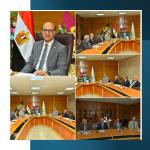
The seminar was attended by Professor Mohamed Adawy, Vice President for Community Service and Environmental Development; Dr. Abu Bakr Mohamed El-Tayeb, Dean of the Faculty of Science; Dr. Essam Fadl Abu Zeid, Vice Dean for Community Service and Environmental Development; along with faculty members, teaching assistants, and administrative staff. The seminar was presented by Dr. Mostafa Morsi, Coordinator of the National Anti-Corruption Strategy at Assiut University.
Professor Mohamed Adawy highlighted that organizing this seminar reflects the University’s community-oriented role in promoting values of integrity, transparency, and good governance, in line with Egypt Vision 2030 for building resilient institutions. He stressed the importance of raising awareness of institutional and administrative corruption among all University affiliates, considering accountability a key pillar for building effective institutions that contribute to sustainable development.
Dr. Abu Bakr Mohamed El-Tayeb underscored the significance of such seminars in clarifying the negative impacts of corruption on society and development, explaining the legislative framework for combating it, and emphasizing the role of academic institutions in instilling a sense of citizenship among students as future leaders. He further stressed the need to cultivate a campus community that understands the risks of corruption and is equipped to apply modern prevention mechanisms within the framework of governance and institutional integrity.
Dr. Essam Fadl Abu Zeid noted that Assiut University is committed to organizing educational events that strengthen societal awareness, given that society itself forms the first line of defense against corruption. He highlighted the critical role of educational institutions in preparing cadres that respect laws and regulations and adhere to principles of integrity, recognizing anti-corruption efforts as a fundamental pillar of building the New Republic.
During his lecture, Dr. Mostafa Morsi provided a comprehensive overview of the National Anti-Corruption Strategy 2023–2030, which focuses on building an efficient administrative apparatus, developing human resource systems, establishing values of integrity and transparency, enhancing the efficiency of governmental services, supporting legislative and judicial structures, strengthening the capacities of oversight bodies, and raising public awareness of corruption risks. He also highlighted the importance of international cooperation and experience exchange, presenting practical examples of mechanisms to reduce corruption within government institutions.